Image: Project Syndicate

By Mercedes D’Alessandro

It may seem obvious to a layperson that failing to support an economy’s labor force must come at a cost. Yet conventional economic models render nearly invisible – or simply wave aside – a dimension of inequality that pervades economic policymaking and macroeconomic outcomes.

Not everyone has lost out from the “polycrisis” that we are now enduring. Perversely, both extreme wealth and extreme poverty have increased simultaneously for the first time in 25 years. Worse, a host of other problems also now demand our immediate attention – from high and rising debt and increasing job precarity to inflation, climate change, and food insecurity.

To reconfigure our economies for growth and sustainable development, we must go back to the intellectual drawing board to identify elements of economic theory and practice that have been overlooked. For example, even though the pandemic exposed deep flaws in how we think about care, many governments and businesses continue to neglect this dimension of the economy.

Image: Project Syndicate

By Robin Willoughby and Nico Muzi

Demographic, environmental, and consumer factors have brought the global agriculture sector to a crossroads. To avoid political hazards, decision-makers in government, industry, and civil society will need to heed the lessons from major transitions in other industries and start preparing.

Disruption is coming to the agriculture sector. Around the world, livestock farmers are leaving the land, policymakers are targeting the harmful environmental and social effects of industrial meat production, and consumers are shifting away from meat to embrace healthier, more sustainable alternatives. With the sector approaching a crossroads, decision-makers in government, industry, and civil society will need to heed the lessons from major transitions in other industries and start preparing.

Image: Geoffrey A. Fowler/The Washington Post via Getty Images/Project Syndicate

By Anne-Marie Slaughter and Alberto Rodríguez Alvarez

Canada, Mexico, and the United States have a chance to forge a regional agenda to position North America as a global leader in digital government services. Having already established a solid foundation for cooperation, they must now build on it.

In Ukraine today and in many other conflicts around the world, the digital domain has become a battleground for cyberattacks and information warfare. Even in normal daily life, digital platforms can endanger citizens and democracies by encroaching on individual privacy, manipulating consumer attention, fostering social isolation, and nurturing extremism. But, while not downplaying these harms, we should also remind ourselves of the many good things that today’s new technologies offer.

Image: Project Syndicate/ Fadel Senna/AFP via Getty Images

Por Laura Chinchilla y María Fernanda Espinosa

El mundo está muy consciente de que la crisis climática es uno de los principales escollos para el desarrollo sostenible. Y, sin embargo, a pesar de las dramáticas pruebas sobre las consecuencias letales del cambio climático, y a pesar de poseer los conocimientos, las tecnologías y los recursos para dar solución al mismo, continuamos en el mismo camino de altas emisiones de carbono que amenaza nuestra supervivencia.

By Chiara Cordelli and Aziz Huq

Texas’s new abortion law subjects women to heightened surveillance and the whims of private parties. If the US Supreme Court upholds the law, it will set back gender relations to an era that precedes the living memory of most Americans.

In 1984, the late US Supreme Court Justice Ruth Bader Ginsburg gave a lecture on why Roe v. Wade, the Court’s 1973 decision recognizing a constitutional right to abortion, was wrongly decided. The case, she explained, should never have been framed as a matter of privacy or reproductive choice alone: Abortion was at bottom a question of gender equality.

Thirty-seven years later, Texas is proving Ginsburg’s point with its draconian and potentially transformative abortion law. If the Supreme Court upholds the law – it just heard oral arguments on whether to permit two legal challenges to proceed – it will set back gender relations to an era that precedes the living memory of most Americans.

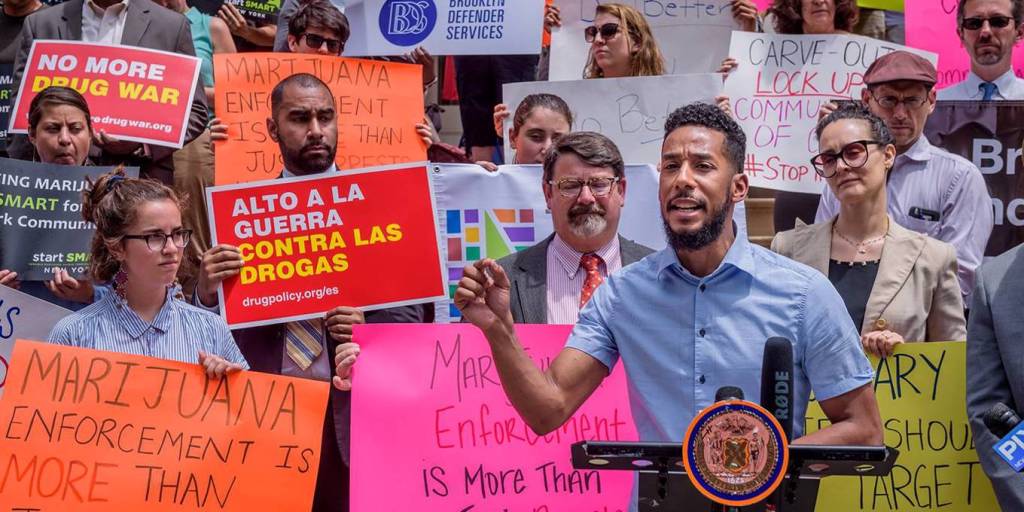
CITY HALL STEPS, NEW YORK, UNITED STATES – 2018/06/20: Council Member Antonio Reynoso – Advocates, community organizations, and Council Members held a press conference and rally at the steps of City Hall, challenging Mayor de Blasio and the NYPDs newly-announced marijuana enforcement policy, urging the Mayor to end racially biased marijuana arrests completely. The Mayor and NYPD Commissioner announced the policy shift yesterday in the culmination of their 30-day review period to assess marijuana enforcement in NYC. (Photo by Erik McGregor/LightRocket via Getty Images)

By Helen Clark, Olusegun Obasanjo, and Ricardo Lagos

With his evidence-based, public-health approach to drug policy, US President Joe Biden is signaling that America’s longstanding strategies of repression and punishment have failed. The US should also champion a similar shift toward harm-reduction policies internationally.

Fifty years ago this week, US President Richard Nixon declared that drug abuse was “public enemy number one” requiring a “tough on crime” approach in the United States and abroad. The “war on drugs,” which expanded in parallel with the global political, military, economic, and cultural hegemony of the US in the post-World War II decades, has delivered the exact opposite of its own stated aims. Today we have both plant-based and synthetic production; low-scale and high-level trafficking of illicit narcotics; disproportionate sentencing and over-incarceration; violence and rights violations; and money laundering and enrichment of organized crime – all strengthened, not weakened, by repressive responses to illegal drugs.

CHILE, VALPARAISO – JULY 04 : View on the historic city and the harbor of Valparaiso on July 04, 2017, Chile. (Photo by Frédéric Soltan/Corbis via Getty Images)

By Felipe Larraín and Pepe Zhang

US-China tensions are unlikely to abate anytime soon, and Latin America will not be able to insulate itself fully from the fallout. But by heeding the lessons of the last three years, the region’s governments and businesses can better position themselves to succeed over the next three years and beyond.

Once a peripheral presence in Latin America, China has become one of the region’s most important partners. Bilateral trade expanded from $12 billion in 2000 to over $300 billion in 2020, raising China’s share of the region’s total trade from 1.7% to 14.4%. China has also become an increasingly significant source of foreign direct investment in Latin America, accounting for nearly 10% of inflows in recent years.