Image: Project Syndicate

By Sonia Guajajara

As co-hosts for this year’s United Nations Climate Change Conference in Belém, the Indigenous peoples and local communities of Brazil’s Amazon region understand what is at stake and will be given a greater voice than ever before. That is good news not only for these communities, but for everyone.

This year’s United Nations Climate Change Conference (COP30) in Belém, Brazil, has been eagerly awaited worldwide. A COP in the Amazon raises expectations for all those who recognize the urgency of climate change and its impact on our lives and environment. That is why Brazilian President Luiz Inácio Lula da Silva is calling this the “COP of Truth.”

Image: Project Syndicate

By José Antonio Ocampo

Latin America’s economies continued to be the worst-performing in the developing world in 2023. To boost economic growth, the region’s political leaders must increase their investments in science and technology, foster regional integration, and reaffirm their commitment to democratic governance.

Latin America has come to the end of its second lost decade of development. Average annual growth hovered just below 0.9% for the 2014-23 period – worse than the 1.3% rate in the 1980s. GDP per capita, however, is projected to be slightly higher in 2023 than in 2013, owing to slower population growth. By contrast, it was not until 1994 that the region’s GDP per capita returned to its 1980 level. Still, Latin America has a severe growth problem.

Image: Project Syndicate

By Mercedes D’Alessandro

It may seem obvious to a layperson that failing to support an economy’s labor force must come at a cost. Yet conventional economic models render nearly invisible – or simply wave aside – a dimension of inequality that pervades economic policymaking and macroeconomic outcomes.

Not everyone has lost out from the “polycrisis” that we are now enduring. Perversely, both extreme wealth and extreme poverty have increased simultaneously for the first time in 25 years. Worse, a host of other problems also now demand our immediate attention – from high and rising debt and increasing job precarity to inflation, climate change, and food insecurity.

To reconfigure our economies for growth and sustainable development, we must go back to the intellectual drawing board to identify elements of economic theory and practice that have been overlooked. For example, even though the pandemic exposed deep flaws in how we think about care, many governments and businesses continue to neglect this dimension of the economy.

Evaristo Sa/AFP via Getty Images

Por Andrés Velasco

Los latinoamericanos tenemos muchos talentos. Uno de ellos es la notable aptitud para gobernarnos mal, como lo ha puesto de manifiesto la pandemia. Seis de los 20 países con más muertes per cápita del mundo a causa del Covid-19 se encuentran en América Latina. Perú encabeza la lista y Brasil ocupa el octavo lugar.

Sin duda que la pobreza, la escasez de camas en los hospitales, y las hacinadas condiciones de vivienda, contribuyeron a la diseminación del virus, pero estos factores por sí solos no explican por qué la región lo ha hecho tan mal. Muchas naciones de Asia y de África padecen de los mismos problemas, pero sufrieron menos muertes per cápita. Incluso países que vacunaron a su población tempranamente, como Chile, –o que al principio de la pandemia parecían exitosos, como Uruguay– han terminado con un desempeño mediocre.

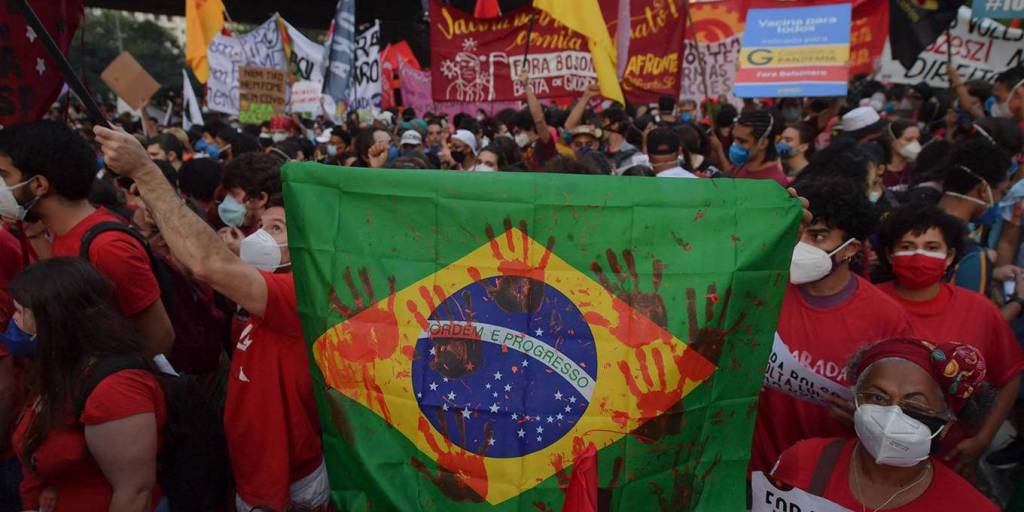
Demonstrators take part in a protest against Brazilian President Jair Bolsonaro’s handling of the COVID-19 pandemic in Sao Paulo, Brazil on May 29 2021. (Photo by NELSON ALMEIDA / AFP) (Photo by NELSON ALMEIDA/AFP via Getty Images)

By Kenneth Rogoff

Most of Latin America is still far from the horrific conditions prevailing in Venezuela, where output has fallen by a staggering 75% since 2013. But, given the ongoing humanitarian catastrophe there, and the specter of political instability elsewhere, investors should not take a sustained economic recovery for granted.

The current disconnect between market calm and underlying social tensions is perhaps nowhere more acute than in Latin America. The question is how much longer this glaring dissonance can continue.

Image: Flickr

By Maggie Wang

This article was originally published here on Human Rights Pulse on April 21, 2021.

“If I become President, there will not be another centimeter of indigenous land [demarcated].”

This statement and statements like it—including several where “centimeter” was replaced by “millimeter”—cropped up frequently in the campaign rhetoric of Brazilian president Jair Bolsonaro. Bolsonaro’s far-right populism and militaristic disregard for minority groups—including Indigenous nations, Black Brazilians, and LGBTQ+ people, among others—have made him immensely popular. It has also made him one of the greatest dangers to environmental conservation and the advancement of Indigenous rights. His presidency has seen large-scale destruction of Brazil’s Amazon Rainforest and encroachment on Indigenous lands by mining and logging companies. Yet, the centrality of Indigenous groups to Bolsonaro’s anti-environment campaign makes them key stakeholders in any effort to protect the Amazon. Since Indigenous rights and conservation are so closely interlinked, it is crucial that conservationists recognize the invaluable knowledge of Indigenous leaders.

This article was originally published on opendemocracy.net.

For the U.S., the Latin American agenda is not a priority. Still, Biden’s arrival at the White House signifies a respite for foreign ministries, who are exhausted by the region’s tension created by Trump. What changes can we expect now?

While Donald Trump is disappointed with the results of November 8th, the world remains incredulous about the difficulties of the great American democracy in recognizing as president-elect the one who won the popular vote with 50.9% and more that 5.5 million more votes than his opponent, who obtained 47.3%.

Although Trump has raised an amendment to the entire election result, alleging massive fraud, he has been unable so far to present any evidence. Biden will be the 46th president of the United States after four years of Trumpism, which has generated turbulence worldwide. Latin America and the Caribbean wonder what the arrival of a Democrat like Joe Biden might mean for them.