Por Susana Cardenas-Soto

La memoria como un remedio para el mal de Tzvetan Todorov identifica cuatro roles principales en las narrativas del bien y del mal: el villano y su víctima; el héroe y sus beneficiarios (8-10). Al examinar la esfera patriarcal de los cárteles mexicanos y sus narrativas, específicamente Fiesta en la madriguera de Juan Pablo Villalobos, podemos ver que las mujeres desempeñan el papel de víctima. Feminicidio se define como “el asesinato misógino de mujeres por hombres…” (Fragoso 283). Fragoso explica que esta violencia es “consecuencia lógica del sistema patriarcal que mantiene la supremacía masculina” (284). Es fácil disolver la empatía a favor de demonizar a los perpetradores cuando leemos sobre los horrores del narcotráfico. Todorov afirma que para evitar una ‘repetición de acontecimientos’ se requiere reflexionar sobre las circunstancias que dieron lugar a actos bárbaros, las motivaciones de los responsables y los medios que emplearon (80). No podemos simplemente culpar a los hombres como Guzmán, o el ficticio Yolcaut, sin mirar los sistemas de patriarcado y explotación económica. Es natural estar sorprendido sobre las realidades de la narco-violencia; para comprender, debemos emplear la empatía. Fiesta en la madriguera revela, a través de la estructura narrativa, la victimización de las mujeres en los cárteles mexicanos, e ilumina simultáneamente la humanidad de sus agresores y el sistema omnipresente que perpetúa la estratificación de clase y género.

By Emanuel Pietrobon

In 2014, according to Pew Research Center, about 69% of Latin America’s population identified as Catholic, in comparison with 92% in 1969. During the same period, the share of Evangelicals grew from 4% to 19%, a growth rate three times larger than the world’s population growth. Within the last decade, Roman Catholicism’s influence has decreased and is no longer followed by the majority of the population in countries such as Guatemala, Chile, Honduras, El Salvador, Nicaragua and Uruguay. This trend is due to the increase of new Christian denominations and irreligiosity, and is being recorded all over Latin America, which may no longer be a Catholic majority by 2030.

Several factors pushed people to abandon Catholicism and to embrace other denominations or atheism such as sexual and accounting scandals involving the clergy, involvement with military dictatorships during the 1970s and 1980s, the crisis of the Catholic welfare model based on supplying public goods and services to villages and slums, secularization processes, and the energetic campaign of proselytism through social and political activism of Evangelical Churches.

By Alexandra Snodgrass

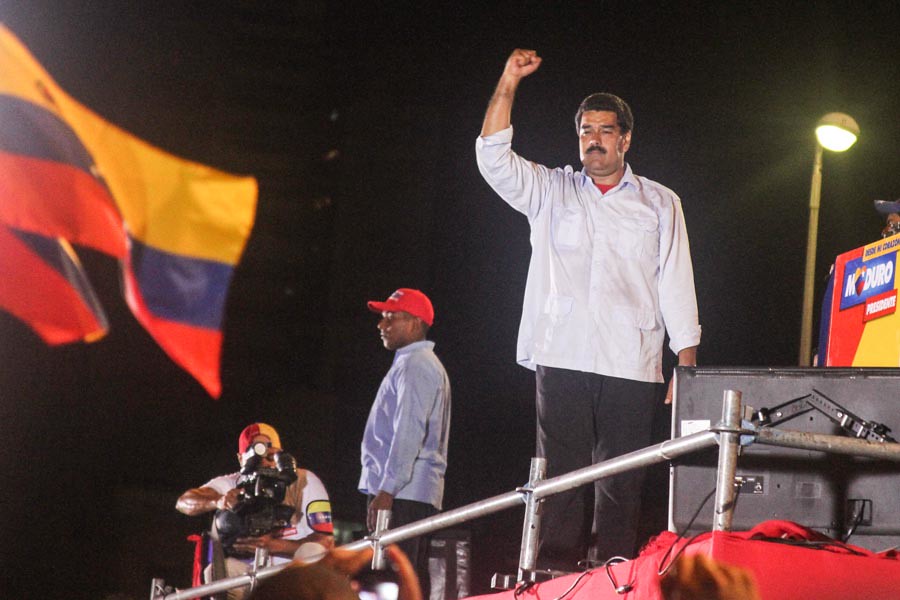
With Venezuela’s elections rescheduled to May 20, President Nicolás Maduro has a long road ahead of him in gaining the support of his citizens. Elections were originally intended to be held April 22, but the National Election Council (CNE) made a last minute decision to push the election date back by one month. The call for a snap election still has some suspecting it was to ensure Maduro’s victory while his opponents largely have no stable footing to run on or are banned from running. A key indicator of Maduro’s future success can be found in the municipal elections, which were held on December 10, 2017. Maduro’s socialist party won 300 of the 355 seats in the overwhelming majority of the municipalities.  

By Domingo de Ramos

          On the road, smoky, more like oily
from Altamira where the little light
forms dreamy partitions in the dust
I grew up one of a kind on the ground-level trembling
grainy abolished and fictionalized
without opal to polish myself
I pulled myself up like a house under the moon
and I said to Diego Is this island or sea?
pointing to the scale model where a recently cut
breadcrumb was floating
No- he mumbled moving his pearly snout
it is Altamira and palpitating cherubs
getting submerged in the glow of streetlights
that turned the air into the mist
of cinemas paradisos and Diego who was more
profound than silence grabbed the whirlwind
demonized from fictions and his city imagined
his equestrian statue among the heaps
and in a click pushed away what was overwhelming him

By Alexia Rauen

Paraguay’s political system has long been dominated by the Colorado Party (Asociación Nacional Republicana – Partido Colorado, ANR-PC). The Colorado Party is pro-West, and has historically – and into present day – restricted civil liberties and stifled opposition parties. This party stems from a brutal 35-year long dictatorship under military leader Alfredo Stroessner, and has retained power for 61 years, controlling the parliament even when Stroessner was removed by a coup in 1989. The Colorado Party has consistently held the presidency except for a brief stint from 2008-2012, which ended in impeachment. The party also holds a majority in the larger branch of Congress, the Chamber of Deputies, and a near-majority in the Senate.

International_Women's_Day_March_(35211930340)

By Laura Schroeder

This International Women’s Day, as we applaud the political, economic, cultural, and social advancements of half the population, there is much to celebrate in the Americas.

In the past decade, there has been a striking increase in political and economic participation of women. Promisingly, government and NGO agendas alike are increasingly prioritizing gender equity as a cross-cutting, pressing issue, and slowly, collaboration is leading to progress. In Bolivia, approximately half of the legislative body is female. Paraguay recently passed Act 5777, providing protection against Gender-Based Violence (GBV), outlawing femicide, and providing services to survivors of sexual violence. Originating in Argentina, the #NiUnaMenos movement against sexual harassment and assault has made great headway across several countries, and has been followed by the US-rooted #MeToo movement.

This is not to say that women do not struggle every day to feel safe, be heard, be recognized for their contributions, and be valued in government and society. Indeed, experts maintain that the global gender gap will close in 79 years for Latin America and the Caribbean and 168 in North America.

Despite this, change makers are pushing forward, inspiring us to join them in their pursuits or to honor their legacies. Without further ado, here are some of the many she-roes that have confronted challenges to advance the status of women in the Western hemisphere.

By Aidan Sanchez

The current political climate in the United States in 2018 is volatile. Among the many contentious topics is Islam’s place in modern Western society. Much of the kindling for growing islamophobic sentiments in the West has come from President Donald Trump. During his 2016 presidential campaign, Donald Trump regularly established that Islam, and by extension Muslims, are public enemy number one. During a campaign rally in December of 2015, Trump infamously called for “​’a total and complete shutdown’ of Muslims entering the United States ‘until our country’s representatives can figure out what the hell is going on.’” In the same speech, Trump conceded that “we have no choice,” and must prevent Muslims from entering the United States. Establishing such a travel ban was, according to supporters, imperative in the interest of preserving national security.​ In his 1993 article ​The Clash of Civilizations?​, Samuel Huntington predicted that cultural differences between the East and West would be the fundamental source for international conflicts in the post-Cold War Era. Using Huntington’s hypothesis, it is possible to identify the historical framework that has led us to where we are now.

During the Cold War, the Soviet Union took the place as the U.S. collective ‘other,’ unifying two distinct conservative political sects: civilizational and ideological, against a common enemy. The civilizational conservatives opposed communism due to ideological reasons. The Soviet Union was an atheist state; its lack of faith ran contrary to Anglo-Saxon Christian traditions. Ideological conservatives stood against communism in the interest of preserving liberty and preventing the global domination of a totalitarian regime. This ‘us versus them’ paradigm is useful in analyzing this time period. Politicians and media outlets alike utilized this worldview to frame international politics because it was easy to identify the ‘good guys’ and ‘bad guys.’ From this perspective, the United States was the good guy, and the Soviet Union was the godless enemy. In a December 1992 memo to his staff, ​New York Times​ foreign editor Bernard Gwertzman wrote, “​In the old days, when certain countries were pawns in the Cold War, their political orientation alone was reason enough for covering them.” However, when the threat of nuclear annihilation subsided, the United States emerged as the clear global hegemon.